Your Brain on Fruit Prints: The Surprisingly Deep Science Behind Summer's Most Craveable Patterns
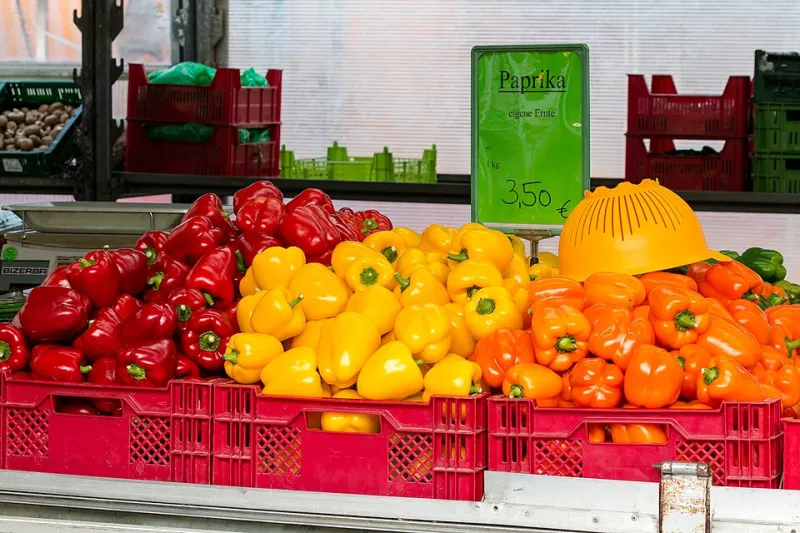
Photo: Dietmar Rabich, CC BY-SA 4.0, via Wikimedia Commons
It's Not Just a Cute Print — It's Neurological
You're browsing your phone on a Tuesday afternoon, minding your own business, and then — boom — a pineapple-print swimsuit stops you cold. You screenshot it. You send it to your group chat. You maybe even buy it before you've fully thought it through. Sound familiar?
Here's the thing: that reaction isn't random, and it's definitely not shallow. Your brain is actually doing something remarkably complex when it encounters fruit-themed patterns. Scientists who study visual perception, color psychology, and consumer behavior have spent years trying to understand exactly why certain images trigger such immediate, visceral responses — and fruit imagery keeps showing up as a fascinating case study.
So let's get into it.
Color Is the First Domino
Before your brain even registers that you're looking at a strawberry or a slice of mango, it's already processing color. And color, it turns out, is one of the most powerful tools in the human sensory experience.
Fruit colors — think juicy reds, electric yellows, deep greens, vibrant oranges, and saturated pinks — tend to cluster in what researchers call the "high chroma" zone. These are colors with strong saturation and brightness, and your visual cortex responds to them faster than it does to muted or neutral tones. It's essentially an evolutionary shortcut: humans learned to associate vivid, saturated colors in nature with ripe, edible, energy-rich food. Your ancestors needed to spot a ripe fig in a dense canopy fast, and your brain still carries that wiring.
At the beach or poolside, this effect gets amplified. Against the backdrop of pale sand, blue water, and bleached-out sunlight, a fruit-printed swimsuit becomes almost magnetically eye-catching. Your brain lights up in the same way it would if you spotted something worth paying attention to in the wild. Except instead of dinner, it's a really good bikini.
Pattern Recognition: Your Brain Loves a Good Story
Humans are pattern-recognition machines. We are wired — deeply, fundamentally wired — to find meaning in visual shapes. It's why we see faces in clouds and animals in wood grain. This tendency, called pareidolia in its more extreme forms, is part of a broader system your brain uses to quickly make sense of the visual world.
Fruit imagery taps directly into this system. Unlike abstract geometric prints, fruit patterns carry instant narrative content. A cherry tells you something. A half-cut watermelon communicates summer, sweetness, abundance. Your brain doesn't have to work hard to decode the image — it recognizes it immediately and begins pulling up everything it already knows and feels about that fruit.
This cognitive shortcut makes fruit prints feel satisfying in a way that's almost hard to articulate. There's a completeness to them. You see a lemon slice on a swimsuit, and your brain quietly files it under: sunshine, refreshing, summer afternoon, good times. That's a lot of emotional payload for one little print.
The Nostalgia Factor Is Real and It's Powerful
Here's where things get really interesting. For most Americans, fruit is deeply embedded in summer childhood memories — watermelon at Fourth of July cookouts, frozen fruit bars dripping down your hand at the pool, the smell of strawberries at a farmer's market on a hot Saturday morning. These aren't just pleasant memories. They're sensory memories, which means they're stored in a particularly vivid and emotionally charged way.
When you see a fruit pattern, especially in the context of swimwear and beach fashion, your brain makes that connection almost instantaneously. Researchers in affective neuroscience describe this as "embodied cognition" — the idea that our emotional and physical memories are tied together in ways that shape how we respond to sensory input. A watermelon-print bikini doesn't just look fun. It feels like something, because your nervous system has been quietly cataloguing watermelon-related experiences for your entire life.
Retailers and designers have long understood this, even if they couldn't always name the mechanism. Fruit imagery in summer fashion isn't accidental. It's a deliberate activation of stored positive emotion.
Why "Playful" Is Actually a Strategic Signal
There's a concept in consumer psychology called "mood congruence," and it basically means that we're drawn to things that match the emotional state we want to be in. At the beach, people aren't looking to feel serious, sophisticated, or restrained. They want to feel free, joyful, a little silly in the best possible way.
Fruit prints signal all of that immediately. They communicate a willingness to be playful, to embrace color, to not take yourself too seriously. For American consumers especially — who tend to approach vacation and leisure culture with a go-big-or-go-home mentality — fruit-printed swimwear functions almost like a uniform for the version of yourself that exists purely in summer mode.
This is also why fruit prints have such strong social performance value. Wearing a bold pineapple one-piece or a cherry-print bikini at a rooftop pool party is a conversation starter. It's an identity signal. It says something about you before you've said a word, and what it says is almost universally positive: fun, confident, comfortable in your own skin.
How Smart Design Amplifies the Effect
The best fruit-inspired swimwear designs don't just slap a fruit on a background and call it a day. The most effective pieces use scale, placement, and color balance deliberately. A large-scale tropical fruit print on a one-piece creates a different psychological impression than a delicate, scattered pattern of tiny citrus slices on a bikini bottom — even if both technically qualify as "fruit prints."
Scale affects perceived confidence and boldness. Placement affects where the eye travels. Color contrast affects how energized or relaxed the overall look feels. When designers get all three right, the result is a piece that doesn't just look good in photos — it feels good to wear, because the visual experience it creates is emotionally coherent from start to finish.
This is the intersection of art and science that makes fashion genuinely fascinating. And it's why, at Summer Fruit Bikini, we think so hard about which prints make it onto the site and which ones don't. The goal has always been to find pieces where the design actually delivers on the emotional promise of the imagery.
The Bottom Line on Your Fruit Print Obsession
Next time you find yourself inexplicably drawn to a mango-print swimsuit or a set covered in illustrated kiwi slices, you can stop wondering if it's a little weird. It's not weird. It's neuroscience.
Your brain is responding to millions of years of evolutionary color processing, a lifetime of positive sensory memories, and a very human desire to use clothing as a form of joyful self-expression. Fruit-inspired fashion works because it hits so many of those systems at once — and it does it in a way that feels effortless, summery, and completely, deliciously right.
Wear the season. Your brain is already on board.